
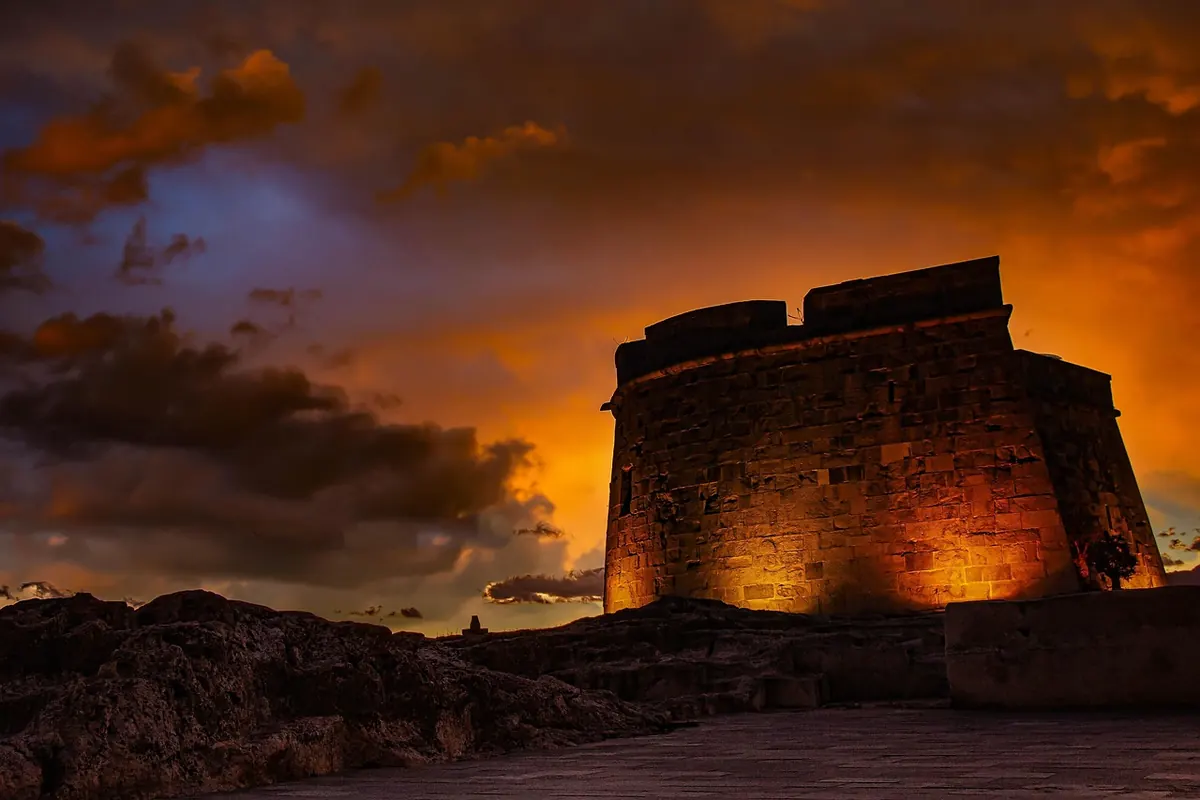
Stand close to the tower and the building stops being a silhouette. You see the batter at the base, where the wall leans out like a heavy boot; the small, mean openings that were never designed to let in light; and, higher up, the generous windows and the clock face that belong to a different century entirely. A tower like this one is not a single building. It is a stack of decisions, each made by people with a different idea of what the structure was for.
That is the most useful way to approach its history: not as a list of dates, but as a series of jobs. Guard post, status symbol, store, ruin, and now a place where people gather for concerts, talks and exhibitions. The architecture records every one of those jobs, if you know where to look.
A Shape Built for Distance, Not Comfort
Medieval towers of this kind were designed around sightlines. Height mattered less than position — a modest tower on the right rise could watch a road, a ford, a valley mouth or an approach from the hills far better than a taller one in the wrong place. The thick lower walls, often a metre or more of rubble masonry, were there to resist impact and to carry the weight above. Narrow windows kept the interior dark and the walls strong, and gave an archer cover while leaving a slot wide enough to shoot through.
Comfort was not part of the brief. Interiors would have been cold, smoky and cramped, with timber floors that have long since been replaced. The people stationed there were not residents in any modern sense; they were on duty. That is why the defensive floors so often feel like a series of small boxes rather than rooms.
Reading the Walls: What the Stone Tells You
Look slowly, and the building separates into phases. Most historic towers show at least three or four, and the joins between them are rarely tidy. A guide or a good information panel will point out the main ones, but you can spot much of it yourself.
- A battered base. The outward slope at the foot is a defensive feature, not decoration. It deflects dropped objects and makes the wall harder to undermine.
- Splayed openings. Internal reveals that widen inward let more light in while keeping the outer slit narrow. If an opening is narrow outside and wide inside, it is original work or a faithful repair.
- Putlog holes. Small square holes in the masonry once held the scaffolding poles. They are a fossil record of how the tower was built, and they are often left deliberately unfilled.
- Blocked doorways and broken arches. A filled-in opening usually means the internal layout changed, or that a later floor was inserted at a different level.
- Large, well-dressed windows. These almost always come after the defensive phase, when the building was being asked to provide light and a view rather than protection.
What Later Hands Added
Once the military need faded, the tower was adapted rather than abandoned. Bells arrived when the building took on a civic or religious role, and with them came the bell frame, the rope openings and the louvred openings that let the sound out. Clocks followed, and their faces are among the most obvious later insertions on any tower — often square, often centred on a wall that was never designed to carry one. Stonework in a slightly different colour, brick patching, iron tie rods and the occasional carved date or coat of arms all mark these later chapters.
From Guard Post to Civic Symbol
The tower's second life was social rather than military. A bell that rang the hours, called people to work, warned of fire or marked the start of a market gave the whole settlement a shared rhythm. In many towns the tower became the tallest thing anyone owned collectively, and it started appearing on seals, boundary markers and the front of the parish register. It was no longer a building you fled to; it was a building you looked up at to know what time it was.
That shift is visible in the fabric. Storeys were added or subdivided. A room that once held weapons became an archive, a grain store or a meeting space. Access improved: external stairs replaced ladders, and doorways were widened at ground level once the need to control entry faded.
The Long Quiet Century
Almost every tower of this age has a period when nobody was paying attention. Roofs leak, timber rots, and the building is quietly repurposed as a store, a workshop or, in some cases, a source of ready-cut stone for neighbouring projects. Ivy and small trees take hold in the joints and do real damage, because roots widen the cracks that frost then opens further.
Restoration, when it came, brought its own arguments. The central question has never really changed: restore to which moment? A tower that has been a fortress, a bell tower and a storeroom cannot be returned to all three at once. Most careful projects resolve this by consolidating what is structurally fragile, keeping later additions that tell part of the story, and using modern materials only where they can be told apart from the old work on a close look. Steel rings, discreet tie bars and new floors that touch the historic walls lightly are the usual solutions.
Turning a Monument into a Venue
Using a historic tower for events is a negotiation between atmosphere and practicality. Old masonry is superb at some things and terrible at others: it absorbs sound unevenly, it holds cold, and it hates moisture and vibration. The work of conversion is mostly invisible. Lighting is aimed at the walls rather than the audience, because glare flattens the stone. Cabling runs in existing channels or in surface trunking that can be removed. Anything fixed to the walls uses the original putlog holes where possible, so no new holes are drilled.
If you are organising something here, the sequence usually looks like this:
- Agree the room's real capacity first, allowing for columns, stairs and circulation, not just floor area.
- Check the acoustic with the seats in place. Sound behaves very differently in an empty stone room.
- Plan heating and ventilation around the building, not against it, and avoid sudden humidity swings.
- Confirm access routes for equipment and for visitors with limited mobility before finalising the programme.
- Build in time for setup and for a quiet check of lighting before the doors open.
The reward is a room with no equivalent. Voices carry, the walls give the light something to land on, and an audience sitting where grain was once stored tends to listen more closely than it would in a modern hall.
Planning a Visit
Check opening hours and any event schedule before travelling, since towers that host cultural programming often close the upper floors during setup. Wear flat shoes — the stairs are worn unevenly and the treads vary in height. Bring a light layer even in summer, as the interior stays cool, and ask at the entrance which floors are accessible if stairs are difficult for anyone in your group. Late afternoon usually gives the best light through the narrow openings. Take a minute at the top to match what you see with what you read on the way up; the landscape explains the building better than any panel.
Photo: AG-Pics / Pixabay